Father Richard Wallace: A Gentle Soul at St. Mary's Cathedral Sydney
A quiet morning encounter with Father Richard Wallace outside St. Mary's Cathedral—where a brief exchange and five peaceful words left a lasting impression.
A Morning Walk Through Sydney's Spiritual Heart
My morning walks through Sydney CBD have become a form of meditation—a way to observe the city waking up, to notice light shifting across architecture, to catch fleeting human moments before the day's rush begins. On this particular morning, my route took me past St. Mary's Cathedral, Sydney's Gothic Revival masterpiece that has anchored the city's spiritual life since the 1800s.
The cathedral's twin spires pierce the Sydney skyline, creating dramatic silhouettes against the morning light. As a street photographer, I'm drawn to this juxtaposition—ancient stone and modern glass, sacred space and secular city, permanence amid constant change. The cathedral steps provide natural framing, the sandstone walls catch light beautifully, and there's always something worth capturing.
The Capture: An Instinctive Moment
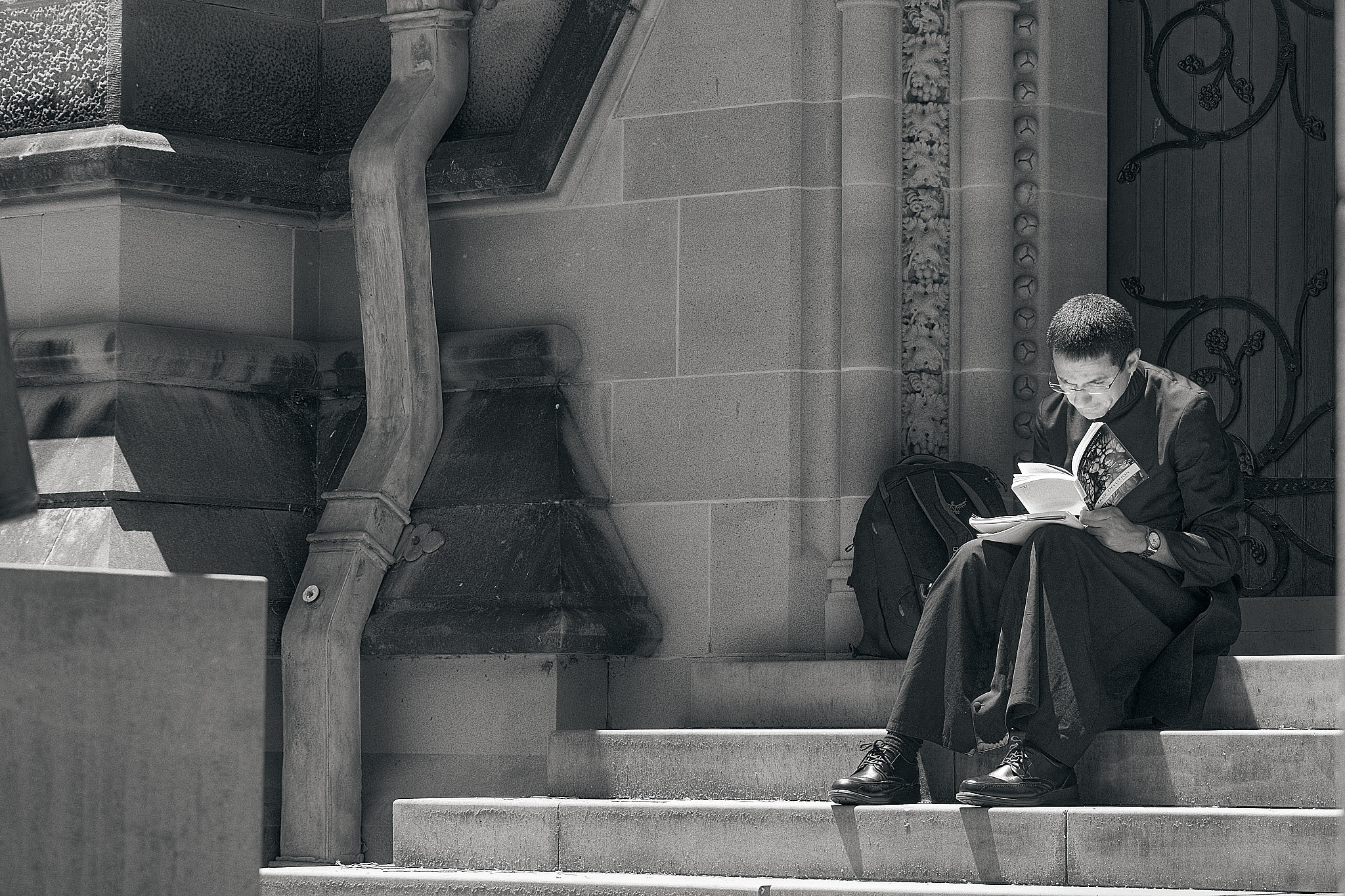
I was composing a shot of the cathedral's facade when I noticed a figure on the stairs—a man in humble posture, seemingly lost in quiet contemplation. The composition was perfect: the Gothic architecture towering behind, morning light creating natural contrast, the human form providing scale and emotional anchor to the massive structure.
The moment felt significant in that inexplicable way photographers recognize—not dramatic or obviously noteworthy, but right. There was something about the stillness of the figure against the monumentality of the cathedral that told a story without words. I captured the frame instinctively, the way you do when you know you've witnessed something worth preserving.
The Ethics of Street Photography
Street photography exists in an ethical gray area—we capture people in public spaces, creating art from unsuspecting moments. While legally permissible in public spaces, I've always believed that ethics matter more than legality. Just because you can photograph someone doesn't mean you should without consideration.
Looking at the image I'd just captured, I knew it was strong—compositionally sound, emotionally resonant, technically clean. But it was also clearly identifiable, and the subject's contemplative posture suggested someone in a private moment despite the public setting. This photograph deserved a conversation.
Five Words and a Feeling of Peace
I approached the man, who I would soon learn was Father Richard Wallace, a Catholic priest serving at the cathedral. My intention was simple: to let him know I'd captured his image and to ask permission to use the photograph in my work.
"Excuse me, Father—I hope this is okay, but I photographed you just now against the cathedral. The composition was too good not to capture. Would you be comfortable with me publishing this photo?"
What struck me immediately wasn't his words, but the quality of his presence. There was no annoyance at being interrupted, no performative humility, no rush to move on. Just calm acknowledgment and what I can only describe as gentle permission. He spoke perhaps five words in response—something along the lines of "Of course, that's fine"—but it was the manner of the exchange that stayed with me.
The Projection of Peace
I've photographed hundreds of people on Sydney's streets. I've had enthusiastic agreements, polite refusals, awkward interactions, and everything in between. But this brief exchange with Father Wallace was different. There was a quality of peace that seemed to emanate from him—not passive disinterest, but active tranquility. In our hurried city, in our anxious age, encountering someone who projects that kind of calm feels almost disorienting.
I thanked him and left, but the feeling lingered. It wasn't anything he said—our exchange was minimal, functional even. It was something about his being. Whatever spiritual practice or life philosophy he embodied, it was visible in that brief interaction. Five peaceful words that somehow made my day better.
Father Richard Wallace: A Life of Service
Father Richard Wallace has been a presence in Sydney's Catholic community for years, serving at St. Mary's Cathedral and contributing to the spiritual life of the city's faithful. While I don't know the details of his entire ministry, that brief morning encounter gave me a glimpse of why people might seek guidance from someone like him.
There's a particular quality required of effective spiritual leaders—the ability to embody the peace they preach, to project the calm they encourage in others, to be genuinely present in small moments as well as significant ceremonies. In our brief exchange, Father Wallace demonstrated exactly that quality.
The Cathedral as Workplace
St. Mary's Cathedral Sydney isn't just a landmark for tourists and photographers—it's a working church, a community hub, and for priests like Father Wallace, a workplace unlike any other. While most Sydneysiders rush past on their way to office towers and coffee shops, the cathedral operates on a different schedule, serving different needs.
Seeing Father Wallace on those cathedral steps reminded me that sacred spaces aren't museums—they're living institutions staffed by individuals committed to service. Whatever one's personal beliefs, there's something admirable about dedicating one's life to providing spiritual guidance in an increasingly secular city.
Photography as Unexpected Connection
This is what I love most about street photography—not just the images captured, but the human connections that sometimes result. Without photography as a catalyst, I would have walked past Father Wallace that morning, perhaps noticed him in the frame but never engaged. The camera gave me a reason to approach, and that approach led to a brief but meaningful human moment.
Street photography is often discussed in terms of composition, light, decisive moments—all valid technical and artistic considerations. But its deepest value might be how it facilitates connection, how it gives us permission to acknowledge each other's existence, to briefly step out of our isolated urban bubbles and recognize our shared humanity.
The Power of Brief Encounters
We live in a culture that privileges intensity and duration—grand gestures, deep relationships, lengthy conversations. But there's profound value in brief encounters too. Sometimes a five-word exchange with a stranger can shift your entire day's energy. Sometimes a momentary connection with someone genuinely at peace can remind you what peace feels like.
Father Wallace and I weren't strangers who became friends. We didn't have a life-changing conversation or exchange contact information. But for those few seconds on the cathedral steps, there was genuine human connection, and it mattered. These accumulating micro-moments of connection are what make urban life bearable, even beautiful.
St. Mary's Cathedral: Sydney's Gothic Heart
I should mention the setting of this encounter, because place matters. St. Mary's Cathedral Sydney stands as one of the city's most significant architectural achievements—a Gothic Revival structure that took decades to complete and continues to anchor Sydney's spiritual geography.
Located at the eastern edge of the CBD, facing Hyde Park, the cathedral occupies premium real estate that could have been sold off for commercial development countless times over. That it remains is testament to the city's decision to preserve sacred space amid relentless urbanization.
Photographing Sacred Architecture
For photographers, the cathedral offers endless opportunities—the interplay of Gothic verticality and Sydney's bright horizontal light, the contrast between ancient building techniques and modern surroundings, the constant flow of people treating the space variously as tourist attraction, spiritual haven, or simply shortcut through the CBD.
But the best cathedral photographs aren't just architectural documentation—they're images that capture the relationship between sacred space and human presence. That's what drew me to the frame of Father Wallace on those stairs: here was a person whose life connects intimately with this building, not as tourist or photographer but as someone who serves its essential purpose.
Finding Calm in the City
Sydney's CBD during weekday mornings pulses with particular energy—professionals rushing to offices, construction noise, traffic, the constant hum of commerce and ambition. It's an environment that encourages speed over contemplation, efficiency over presence, productivity over peace.
That's what made encountering Father Wallace's calm so striking—it was counter to every energetic current flowing through that space. Here was someone moving at a different pace, operating on a different wavelength, embodying different values than the surrounding rush.
We all need reminders that the city's frenetic energy isn't mandatory—that it's possible to move through urban space with grace and calm, that hurry is often habit rather than necessity. My brief exchange with Father Wallace served as exactly that reminder.
The Photograph as Document
Looking at the final image—Father Wallace framed against St. Mary's Cathedral's Gothic grandeur—I see more than I initially captured. The photograph documents not just a person in a place, but a quality of being, a moment of stillness, a different way of inhabiting the city.
This is what the best street photography does: it preserves not just what people look like, but something of who they are, how they move through the world, the particular energy they carry. Technical skill can create compositionally sound images, but capturing actual humanity requires presence and luck in equal measure.
Permission and Publication
Because Father Wallace graciously gave permission for me to publish this photograph, I can share it as part of my ongoing documentation of Sydney street life. His openness allowed this image to move from private capture to public art, from momentary observation to lasting document.
This generosity—the willingness of strangers to allow their images to be shared—is what makes street photography possible as a practice. Every person who says "yes" to a photographer's request contributes to the collective visual record of how we lived, how we looked, who we were.
Reflections on Faith and Photography
I'm not a religious person, but I have deep respect for what faith provides to those who practice it seriously—community, meaning-making frameworks, ethical guidance, and in the best cases, that quality of peace I witnessed in Father Wallace. There's something admirable about individuals who dedicate their lives to helping others find calm in chaotic times.
Photography serves as my own form of spiritual practice—a way of paying attention, of honoring the present moment, of finding meaning in the seemingly ordinary. Perhaps that's why this encounter resonated: I recognized in Father Wallace someone else engaged in a practice of presence, just expressed through different methods.
Conclusion: Small Encounters, Lasting Impact
That morning outside St. Mary's Cathedral lasted only minutes. I captured a photograph, approached the subject, received permission, thanked him, and moved on. By objective measures, it was insignificant—no dramatic events, no profound conversation, just five peaceful words and a feeling.
Yet weeks later, I'm still thinking about that exchange. The photograph is technically strong, yes, but what makes it valuable to me is the memory of the encounter it represents—that brief, unexpected reminder of what peace looks like, feels like, sounds like.
To Father Richard Wallace: thank you for those five words, for that moment of calm, and for the permission to share this image. You made a photographer's morning better and reminded me that the best gifts are often the simplest ones—presence, peace, and permission.
About This Series
This photograph is part of my ongoing documentation of Sydney's people and places. Through street photography, I aim to capture the human dimension of urban life—the faces, moments, and encounters that reveal what it means to live in this city. Every photograph tells a story, but some stories, like this one, extend beyond the frame into genuine human connection.
If you've been photographed by me on Sydney's streets and would like to know more about the image or request a copy, please reach out. Street photography works best as a collaborative art—subjects and photographer together creating the visual record of our shared urban experience.